
We are a global operator of essential infrastructure








The 4th Pastoreo en las Redes Conference to explore how extensive livestock farmers can be rewarded for helping to prevent wildfires and promote biodiversity
Redeia, Enagás, Agrovidar, Fundación Global Nature and UNED Ponferrada host the 4th Pastoreo en las Redes Conference to explore financial compensation for livestock farmers providing ecosystem services through herd grazing.
Taking place on 29 and 30 October in the mountains of León, the event will bring together experts in livestock farming, forestry and biodiversity, alongside a field visit to grazed areas.
Primary school pupils from La Pola de Gordón will participate in two hands-on biodiversity measurement workshops, focusing on insect trap sampling and species identification.
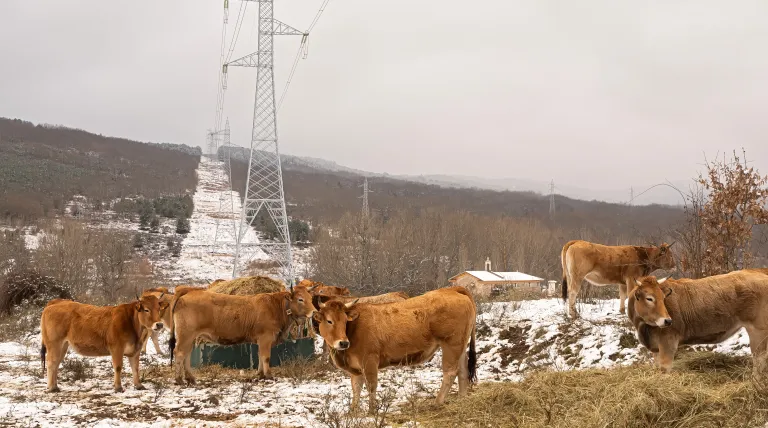
Herd grazing plays a vital role in controlling vegetation, reducing the risk of wildfires, improving soil quality and boosting biodiversity. But who pays livestock farmers for these benefits – the so-called ‘ecosystem services’ – and how are they compensated? What methodologies are currently being used to measure and monetise these services?
To address these and other questions, Redeia, Enagás, Agrovidar, Fundación Global Nature, and UNED Ponferrada are hosting the 4th Pastoreo en las Redes Conference (Grazing in the Grids) on 29 and 30 October in La Pola de Gordón (León). The event is supported by the Provincial Council of León, La Pola de Gordón Town Council, the Alto Bernesga Biosphere Reserve, and the León Mountain Livestock Farmers’ Association.
Experts in livestock farming, forestry and biodiversity from the private, public and academic spheres will share experiences and knowledge. They will discuss how grazing contributes to ecosystem conservation, wildfire prevention and sustainable development in mountain areas – with a particular focus on methods to assess these services and properly compensate those who provide them.
In this regard, the conference will present results from four initiatives currently measuring ecosystem services. The first is Pastoreo en las Redes (Grazing in the Grids) in the mountains of León, where Redeia – Red Eléctrica’s parent company – and Enagás are leveraging extensive livestock farming and herd grazing to manage vegetation under power lines and gas pipelines. With technical support from Agrovidar and the participation of local livestock farmers and shepherds, grazing complements conventional mechanical vegetation clearing. After five years of operation, grazing along this energy infrastructure is successfully creating active biodiversity corridors.
The second project is the Orekan initiative in Navarra, where the Regional Government of Navarra compensates livestock farmers financially for adopting climate- and eco-friendly practices in mountain hay meadows. The third is Fundación Global Nature’s initiative at the El Baldío dehesa in Cáceres, a benchmark in the use of planned rotational grazing and regenerative management. Finally, the fourth is the Ovihuec project in Vilamós, in the Valle de Arán (Lleida), led by the Institute of Agri-Food Research and Technology (IRTA) of the Regional Government of Catalunya.
From scientific knowledge to land management
The conference will explore the historical role of grazing as a key tool for conserving mountain ecosystems, making sustainable use of natural resources, and keeping rural areas thriving. It will also address the challenges posed by rural depopulation and the lack of land management – key drivers behind the degradation of extensive areas and the rising risk of major wildfires. To this end, a keynote presentation on the specific case of the Cantabrian Mountains will be delivered by Juan Busqué, President of the Sociedad Española de Pastos (Spanish Pasture Society) and researcher at the Agricultural Research and Training Centre of Cantabria.
The conference will also examine how new technologies – including virtual fencing devices, AI and sensor technology (real-time data collection tools like GPS collars and drones) – can support livestock and land management. At the same time, experts will assess the impact of certain veterinary treatments on insects that drive organic matter recycling in pastures, a process essential to keeping farming ecosystems healthy and balanced.
Finally, the conference will highlight the importance of collaboration between researchers, land managers, landowners and livestock farmers in developing new management models to protect the natural wealth of forests and mountain areas.
The event will conclude with a field visit to the Pastoreo en las Redes sites in Casares de Arbas and Folledo. Participants will observe on site how livestock control the growth of woody vegetation and how grazing can help increase biodiversity, among other benefits.
Alongside the main agenda, local school students in Years 5 and 6 from the Federico García Lorca Primary School in La Pola de Gordón will participate in a practical biodiversity measurement study involving two field trips. On Wednesday, they will explore the surrounding area and set up sampling traps; on Thursday, they will collect samples, identify species and classify the insects found.
Download