
We are a global operator of essential infrastructure








Redeia's Marine Forest project in Mallorca
Redeia's Posidonia forest in Pollença achieves a 93% survival rate six years later
- The results of this initiative reflect the success of the replanting technique developed by Red Eléctrica and IMEDEA since 2014.
- Redeia's Marine Forest presents a new 'Posidonia planting guide', making it available to society and organisations to replicate this marine planting technique in other parts of the Mediterranean.
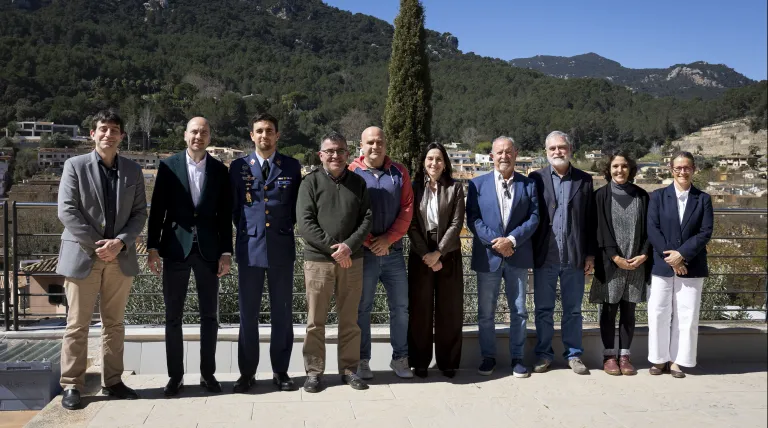
Redeia and the Mediterranean Institute for Advanced Studies (IMEDEA-CSIC) presented today in Esporles (Mallorca) the results of the active restoration project of 2 hectares of Posidonia oceanica in the Bay of Pollença, carried out in 2018 by Red Eléctrica, the company responsible for the transmission and operation of the electricity system in Spain. Data from the 2025 final project report show that the survival rate of the recovered specimens reaches up to 93% six years after planting.
This Posidonia recovery project in Pollença arose from the work for the interconnection between Ibiza and Mallorca and subsequently became the origin of Redeia's Marine Forest platform, whose purpose is to promote the conservation and restoration of marine ecosystems using science-based methodologies, as well as to promote environmental education and outreach. Currently, alongside Mediterranean Posidonia, Marine Forest has several projects focusing on other marine habitats, such as gorgonians in the Atlantic and, soon, macroalgae.
Redeia's Sustainability Director, Laura Quintana, highlighted that 'the results of Redeia's Marine Forest project in Pollença are very encouraging. In a short time, we have managed to advance the restoration of marine biodiversity in this part of the Mediterranean. Thanks to the collaboration between companies, civil society, public administrations, the scientific community, and the Third Sector, we are able to highlight the value of these ecosystems and achieve a very positive ecological and social impact.'
A pioneering and replicable initiative
During the event, a new edition of the 'Posidonia planting guide' was also launched, detailing the scientific planting technique used, with the aim of sharing it with society so that it can be replicated by other organisations. The guide, which can now be consulted here, includes the experience acquired over these years, thus contributing to the recovery and conservation of this unique habitat of high ecological value.
Between 2018 and 2020, Red Eléctrica and IMEDEA transplanted 12,800 Posidonia rhizome fragments in the Bay of Pollença with the collaboration of the Regional Ministry of Agriculture, Fisheries, and Natural Environment of the Government of the Balearic Islands, and the Pollença Military Aerodrome. They used an innovative technique that includes the phases of collecting leaf bundles resulting from natural fragmentation due to marine dynamics, preparing the specimens, planting carried out by divers who anchor each rhizome fragment to the seabed, and, finally, monitoring.
Within the framework of the project, in addition to the survival rate, the development of the transplanted rhizome fragments is monitored annually. The average size remains similar to what it was at the time of transplanting, with a slight downward trend that halts 5 years after planting, although some units have increased in size by up to 32%.
The data demonstrate the slow growth rate of Posidonia and, therefore, of the recovery of the meadows, which, in turn, corroborates the need to prioritise conservation initiatives for this species.
The objective of the restoration is to recover the structure of the Posidonia, its ecological functioning, and the associated ecosystem services. In this regard, an analysis of the biodiversity of epifauna (part of the fauna community formed by organisms living in the leaf canopy of the Posidonia meadow) and fish has also been carried out to evaluate the recovery of ecological functioning in the planted area, comparing it with the nearby natural Posidonia meadow. It has not been possible to conclusively verify an effect on the abundance of epifauna in the plantation, and the response of the fish community is only faintly observed in juvenile specimens.
Other Marine Forest initiatives
The Marine Forest platform is part of Redeia's Comprehensive Impact Strategy, which develops its initiatives with an integrative approach of engaging with local communities and collaborating with public administrations, local bodies, associations, the Third Sector, research institutes, etc.
Thus, the platform works hand in hand with public administrations on other passive and active restoration projects of Posidonia meadows in the Mediterranean, such as in Altea (Alicante) where ecological buoys will be installed to prevent damaging anchoring. In the Atlantic, it collaborates with the Amicos Association and local fishermen for the conservation and restoration of marine populations of gorgonians in the surroundings of the Atlantic Islands National Park, in the Rías Baixas.
The ongoing collaboration with the University of Seville in a scientific study to understand the impact of the invasive algae (Rugolopteryx okamurae) also stands out. In the educational field, Redeia and Ecomar are scheduled to hold 15 educational workshops in schools across Spain during 2026 to promote environmental education and awareness-raising. Since 2024, more than 800 schoolchildren have participated in these workshops.
Downloads