
We are a global operator of essential infrastructure










Coordinated by Fundación Global Nature
The Ballesteros Lagoons, one of the most unique natural areas in Cuenca, will be restored to good environmental condition through a public-private partnership supported by Redeia
- The initiative will receive nearly €4 million in funding from various organisations to restore more than 280 hectares of this natural landscape, unique in Europe, which has been affected by agricultural activity for decades.
- The LIFE Ballesteros project is a public-private partnership coordinated by the Global Nature Foundation and is co-funded by the European Union, Redeia and the Cuenca Provincial Council. It also benefits from the collaboration of the Regional Government of Castilla-La Mancha and the local councils of Arcas, Valdetórtola and Villar de Olalla.
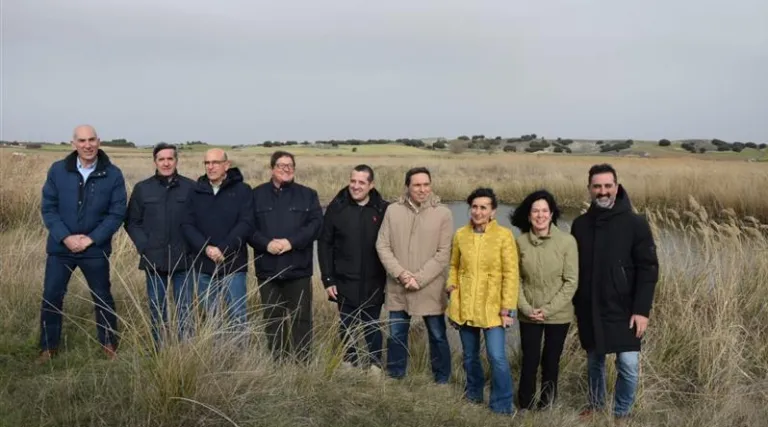
The Global Nature Foundation, Redeia, the Cuenca Provincial Council and the Regional Government of Castilla-La Mancha presented on Tuesday, coinciding with World Nature Day, the LIFE Ballesteros Lagoons Project, which will work towards the comprehensive restoration, expansion and conservation of the natural habitats of the Ballesteros Lagoons, a group of circular gypsum wetlands located in the province of Cuenca, a natural landscape that is very rare in Europe.
This area, situated within the Ballesteros Lagoon Complex Nature Reserve, has been affected in recent decades by agricultural activity and the extraction of water for irrigation, which has caused the floodplain to dry up and severely degraded the vegetation in the area, which has now almost disappeared. Thanks to the LIFE Ballesteros project, which has just begun, it will be possible to restore more than 280 hectares between 2026 and 2029, so that one of the most unique ecosystems in the Natura 2000 network can recover its natural state.
The initiative has a budget of €3.9 million, co-financed by the European Union through the LIFE programme, Redeia and the Cuenca Provincial Council. It also benefits from the collaboration of the Regional Government of Castilla-La Mancha and the local councils of Arcas, Valdetórtola and Villar de Olalla.
Comprehensive collaboration
During the presentation of this initiative, Eduardo de Miguel, director of the Global Nature Foundation, explained that “LIFE Ballesteros is a project that can only succeed thanks to collaboration between public authorities, farmers and the local community. We have reached preliminary agreements with 18 landowners representing 94% of the protected area’s land, as part of a land purchase process led by the EU, which will enable us to move towards a complete and lasting restoration of the ecosystem”.
“We are also learning from previous experiences such as the LIFE El Hito project in the province of Cuenca, where land acquisition, wetland restoration and collaboration with farmers demonstrated that environmental recovery is compatible with the sustainable development of the area. That project served as a benchmark and we are now applying those lessons in Ballesteros”.
For her part, Redeia’s manager in Castilla-La Mancha, Patricia Crego, highlighted “Redeia’s commitment to the conservation and restoration of ecosystems through collaboration and support for local organisations via our Comprehensive Impact Strategy, with the aim of generating a positive impact in the region where our facilities are located”. In this regard, she stated that “Redeia is aware of the rich ecosystems in the province of Cuenca, which is why we are promoting various initiatives of lasting value”.
Likewise, the President of the Cuenca Provincial Council, Álvaro Martínez Chana, emphasised that with Global Nature “we are backing a sure thing”, as demonstrated by the Laguna del Hito project, which has enabled the restoration of this area and directly attracted more than 60,000 visitors and 3,500 schoolchildren, something that has a positive impact on the people living in this region. He also expressed his strong support for this public-private collaborative approach, which aims to forge partnerships between the LIFE Project and civil society in various settings – such as local councils, farmers and local residents themselves. This demonstrates a different way of supporting the natural environment without hindering rural development.
For her part, the Director-General for the Natural Environment and Biodiversity of Castilla-La Mancha, Susana Jara, reaffirmed the regional government’s commitment to the conservation and restoration of wetlands, highlighting the importance of collaborative initiatives such as this project. Jara emphasised that “Castilla-La Mancha boasts an exceptional natural heritage”, and that these actions help to protect “unique ecosystems that form part of our identity”. She highlighted the strategic role of these areas in the fight against climate change, noting that “they regulate the water cycle, store carbon and are home to extraordinary biodiversity”, singling out the Ballesteros lagoon complex and the Moscas River valley as priorities. "Protecting our wetlands today means safeguarding natural resources, biodiversity and well-being for future generations," she stated.
An exceptional geological phenomenon in a natural area unique in Europe
The Ballesteros Lagoons are home to more than thirty sinkholes and uvalas formed by a geological phenomenon unique in Europe. The dissolution of gypsum creates an exceptional landscape of lagoons: a living process characterised by the slowness of its evolution; yet the processes affecting the gypsum in the centre of the province of Cuenca are extraordinarily rapid, a peculiarity of this gypsum that caused the most recent collapse less than 20 years ago. These sinkholes and uvalas are formed as a result of an active karst process on a gypsum aquifer: if these depressions are connected to the underlying aquifer, they receive water from it and can thus become permanent or semi-permanent lagoons; conversely, if they are not connected, they are only flooded temporarily when it rains or if the water table rises.
A comprehensive transformation
Through the LIFE Ballesteros project, up to 94% of the protected area’s surface will be acquired for restoration, ending its agricultural use. The environmental restoration will remove 3.5 kilometres of drainage channels and artificial canals, as well as irrigation infrastructure and debris. The project will work to replenish aquifer levels and induce temporary flooding processes across 120 to 145 hectares.
The initiative also includes the official expansion of the Special Area of Conservation (SAC) boundaries by 28% and the updating of its Management Plan. Furthermore, the area of natural habitats will increase tenfold, rising from the current figure of less than 30 hectares to almost 280.
In this regard, another of the project’s key objectives is to restore the masiega grasslands (Cladium mariscus), a native species that serves as a refuge for dozens of unique species of birds, amphibians and invertebrates. These grasslands have almost completely disappeared and now only grow on the shores of the lagoons: where hectares of dense vegetation once stretched out, today there are barely any small, scattered patches left. To reverse this situation, 250,000 plants will be planted to increase their current area sevenfold, restoring one of the wetland’s most characteristic ecosystems.
A commitment to collaboration and awareness-raising
To ensure the long-term sustainability of this recovery, land stewardship agreements will be promoted with local farmers to help reduce the use of fertilisers and pesticides across 500 hectares around the SAC. It will also feature a scientific monitoring system that will include detailed botanical mapping, hydrochemical studies, the analysis of charophyte communities – key to assessing water quality – and entomological studies focused on aquatic invertebrates, particularly endemic or highly threatened species, as indicators of the ecological status of the system.
At the same time, an ambitious programme of public awareness and engagement will be developed, including the creation of a 1.5-kilometre interpretive trail, two car parks to manage visitor numbers, educational activities for 5,000 schoolchildren, and a travelling exhibition that will tour 50 municipalities in Cuenca. Innovative financial tools, such as biodiversity credits and water footprint metrics, will also be explored to involve the business sector in the conservation of the area.
Downloads