We are a global operator of essential infrastructure







International Fascination of Plants Day
IUCN and Redeia strengthen their partnership to protect Posidonia seagrass in Cabo de Gata (Almería)
- The IUCN and Redeia’s Marine Forest platform are promoting awareness of the value of Posidonia oceanica, an endemic Mediterranean seagrass species that is key to the health of marine ecosystems.
- At an event held at the Casa de los Volcanes in the Cabo de Gata-Níjar Natural Park, experts highlighted the need to integrate scientific knowledge, public management, and social engagement in the conservation of Posidonia meadows.
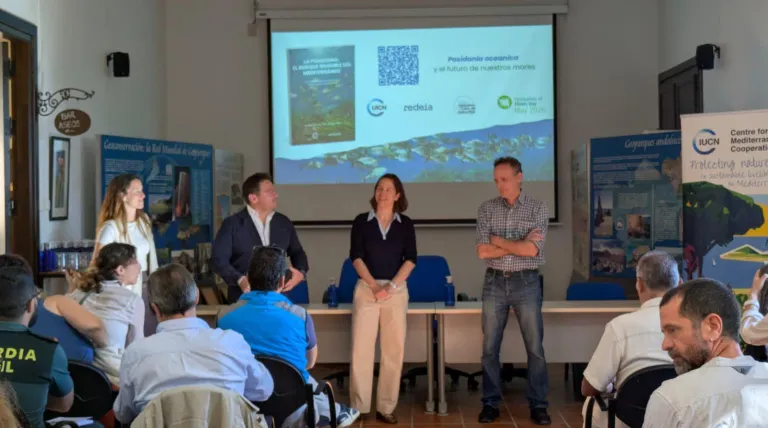
The IUCN Centre for Mediterranean Cooperation and Redeia have strengthened their collaboration in support of marine biodiversity during the event ‘The hidden marine plant: Posidonia oceanica and the Future of Our Seas’, held at the Casa de los Volcanes in the Cabo de Gata-Níjar Natural Park.
The meeting — which was attended by Álvaro Borrego Iglesias, María Gutierrez Lorente y Leopoldo Moro López (Redeia), Salvador Parra Gómez (Cabo de Gata-Níjar Natural Park), Mercedes Muñoz Cañas (IUCN Med), and had the support of Asociación Hombre y Territorio, brought together 30 experts, public officials, scientific institutions, and local stakeholders. Together, they discussed the main challenges surrounding the conservation of Posidonia oceanica, a marine plant crucial to the balance of the Mediterranean.
The event, helded to mark the International Fascination of Plants Day, highlighted one of the sea’s most valuable ecosystems, which produces oxygen, improves water quality, protects beaches from erosion, and provides shelter for numerous marine species. As emphasised by different speakers, ‘when Posidonia is healthy, the sea is healthy too.’ The programme combined technical presentations such as ‘The underwater forest we cannot see’ with participatory sessions aimed at collaboratively addressing the real challenges involved in conserving these seagrass meadows in Cabo de Gata.
One of the key messages of the event was the importance of supporting efforts to integrate scientific knowledge, public management, and social engagement in order to ensure the conservation of this ecosystem, particularly in highly valuable and sensitive environments such as Cabo de Gata, where biodiversity, tourism, and traditional activities coexist.
Understanding to protect: A new educational publication
The publication ‘Posidonia: the invisible forest of the Mediterranean’ was also presented as part of the event. This awareness tool is being promoted within the framework of this collaboration and is part of an ongoing social media campaign. It highlights that Posidonia is not seaweed, but a marine plant exclusive to the Mediterranean Sea, where it forms extensive meadows and can live for centuries. The publication focuses on the urgent need to protect this ecosystem, whose population trend is declining, and encourages citizens to become involved in its conservation through a responsible use of coastal areas and greater environmental awareness. It also reflects Redeia’s commitment through its Marine Forest platform. This initiative is part of the company’s Comprehensive Impact Strategy and focuses on ecosystem restoration, scientific outreach, and environmental education in collaboration with multiple stakeholders.
A shared commitment to the future of the Mediterranean
The event concluded with the identification of possible initiatives and shared lines of action, reinforcing the need to advance nature-based solutions and collaborative models that help protect and better understand marine biodiversity over the long term.
IUCN and Redeia thus reaffirm their commitment to the conservation of Posidonia oceanica, an essential element not only for biodiversity, but also for coastal resilience, the local economy, and the wellbeing of future generations.