

We are a global operator of essential infrastructure








'Naturaleza en red' ('Nature on the grid'), science to protect biodiversity
The Spring Ringlet butterfly, an endangered species in Cataluña, found for the first time beneath electricity transmission lines
- UAB researchers, supported by Redeia, are studying the role of security corridors beneath power lines as safe havens for biodiversity, where a wide variety of flora and fauna can thrive.
- The third phase of the 'Naturaleza en red' project, which will run until 2029, will apply the knowledge gained about these ecological corridors to develop and implement management and conservation measures.
- Researchers will carry out pilot forest management schemes, establish a network of sampling sites across Spain and develop new knowledge transfer and visualisation tools.
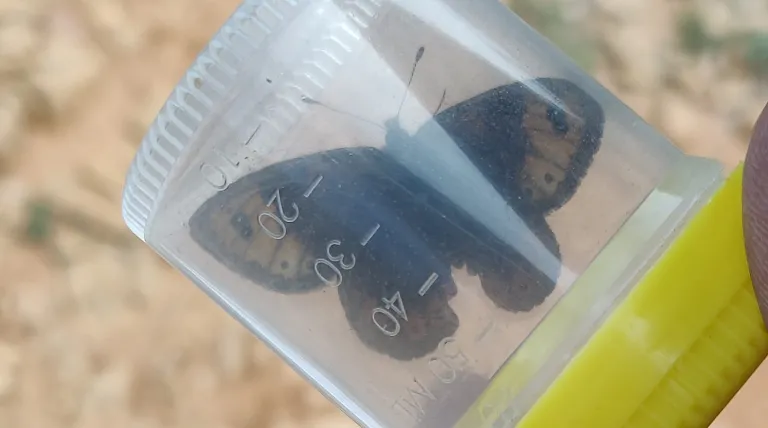
The Universitat Autònoma de Barcelona (UAB) has recorded the presence of the Spring Ringlet butterfly (Erebia epistygne) for the first time beneath Red Eléctrica's electricity transmission lines. The species is classified as 'Endangered' in Cataluña.
The discovery was made during the third phase of 'Naturaleza en Red', a research project launched in 2020 by the UAB and Redeia through its subsidiary Red Eléctrica. The project examines the role of security corridors beneath transmission lines as safe havens for biodiversity by analysing the flora and fauna found in these areas, assessing the impact of forest management and mapping sections of particular environmental interest.
The collaboration between Red Eléctrica and the university has made it possible to identify this butterfly, which is found mainly in mountainous areas of Cataluña. The abandonment of traditional livestock farming, which has allowed woodland and scrubland to expand, has exposed the species to the loss and fragmentation of open habitats in recent decades, resulting in a significant decline in its population.
The presence of this species beneath high-voltage power lines is a further example of the ecological value that these managed areas can offer. They provide safe havens for numerous species of flora and fauna typically found in open habitats, which are becoming increasingly scarce.
Redeia's Sustainability Director, Laura Quintana del Val, highlights: 'With "Naturaleza en Red", we are demonstrating that electricity infrastructure can create opportunities for biodiversity when managed according to scientific principles. Continuing this partnership allows us to expand our knowledge of these ecological corridors and the species that inhabit them, and to translate that knowledge into targeted conservation measures through our Comprehensive Impact Strategy.'
Expanding scientific knowledge of biodiversity beneath power lines
Since its launch in 2020, the 'Naturaleza en Red' project has focused on studying pollinators and the flora associated with open spaces created through forest management beneath electricity transmission lines. This research has assessed the diversity and abundance of butterflies, Hymenoptera and Diptera, as well as identifying numerous distinctive plant species, including several types of orchid. The recent discovery of Erebia epistygne comes in addition to the earlier finding of the Alcon blue butterfly (Phengaris alcon), which is also threatened in Cataluña, further highlighting the importance of these corridors as biodiversity reservoirs.
The third phase of the project, which will run until 2029, marks a significant step forward in this initiative, moving towards validating and implementing management measures to help conserve the most vulnerable pollinator species and biodiversity as a whole.
The project's new objectives include launching pilot forest management schemes, establishing a network of sampling sites across different regions of Spain and developing new tools for transferring and visualising the knowledge gained.
The findings will help identify the sections of the grid with the greatest ecological value, improve vegetation management practices beneath power lines and establish a methodology that can gradually be rolled out across the country.
The research team at the Universitat Autònoma de Barcelona, comprising Maria Font, Xavier Munill and Ana Morton, emphasises the importance of continuing to study the biodiversity found in these areas: 'The discovery of Erebia epistygne highlights the importance of studying the biodiversity found in security strips beneath power lines. Scientific monitoring of these areas allows us to gain a better understanding of the species they support and assess how their management can contribute to biodiversity conservation.'
Downloads