
We are a global operator of essential infrastructure









Preserving marine ecosystems
Redeia to restore gorgonian populations and track cetaceans in the Bay of Vizcaya
- The ‘Mar de Gorgonias’ reef restoration project will be launched in the areas surrounding the electricity interconnections between Vizcaya and France and between the Peninsula and Ceuta, while ‘Ecos del Océano’ will study the relationship between marine mammals and commercially important species in the Bay of Vizcaya.
- Both projects are being presented at the third edition of Redeia’s Marine Forest Scientific Seminar, which brings together 120 experts in Vizcaya today and tomorrow to promote the conservation and restoration of marine ecosystems.
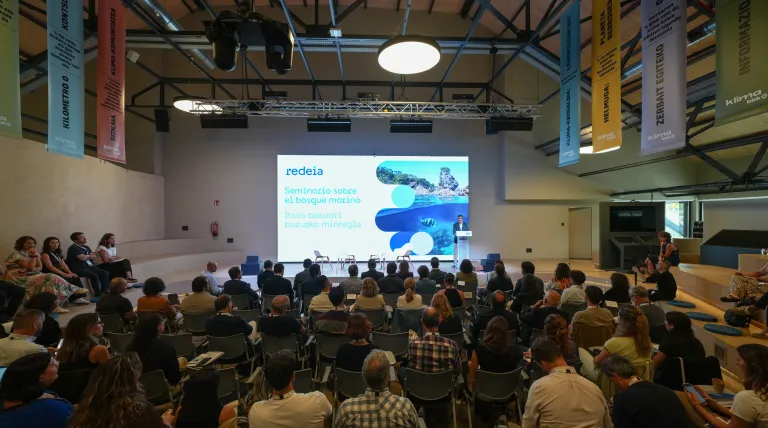
More than 120 experts in marine conservation, representatives of government bodies, companies, environmental organisations and fishing industry professionals are meeting today and tomorrow at the third Redeia Marine Forest Scientific Seminar to analyse the challenges and threats facing marine habitats and showcase initiatives that contribute to ocean protection and recovery.
The event, held at BBK Klima in the Urdaibai Biosphere Reserve in Busturia (Vizcaya), is organised by Redeia through its Marine Forest platform, a strategic company initiative launched in 2024 to promote the conservation of marine ecosystems.
The opening session was attended by Antonio González, Redeia’s Manager of Northern Regional Office; Adolfo Uriarte, director of Natural Heritage and Climate Change Adaptation at the Basque Government; and Koldo Lekue, councillor for the Environment at Busturia Town Council.
Fernando Magdaleno, deputy director-general for Terrestrial and Marine Biodiversity at the Ministry for the Ecological Transition and Demographic Challenge, delivered the opening lecture on the National Nature Restoration Plan for Marine Ecosystems. The plan is a key tool for complying with the European Union’s Nature Restoration Regulation, which aims to restore degraded habitats.
In addition, Red Eléctrica, Redeia’s subsidiary responsible for electricity transmission and the operation of the Spanish electricity system, presented the progress made by the Marine Forest initiative throughout 2026.
In particular, it outlined two projects to be developed in País Vasco. The first, ‘Mar de Gorgonias’, is an initiative to restore reefs located around the electricity interconnections between Gatika (Vizcaya) and France – scheduled to start in 2027 – and between the Peninsula and Ceuta, where the first steps were taken during summer 2026. In addition, ‘Ecos del Océano’ has been launched in collaboration with AZTI to study the presence of marine mammals and commercially important fish species that coexist with the new interconnection between Vizcaya and France.
‘We believe that infrastructure development and marine conservation must go hand in hand. The projects we are presenting at this edition of the Marine Forest seminar, such as ‘Mar de Gorgonias’ and ‘Ecos del Océano’, reflect our commitment to taking action on the ground, drawing on the best available scientific knowledge and helping to protect marine biodiversity through initiatives designed to deliver long-term, transformative change,’ said Laura Quintana, Redeia’s director of Sustainable Development.
The first day of the seminar also featured a discussion on the role of protected areas in marine conservation, with representatives from the Basque Government, the Government of Islas Baleares, the Regional Government of Andalucía and the Ministry for the Ecological Transition and Demographic Challenge. Scientists from IMEDEA-UIB-CSIC, CEAB-CSIC and ICM-CSIC have also presented the scientific projects for the conservation and management of marine ecosystems that they are carrying out in collaboration with Marine Forest. These sessions were complemented by participatory workshops on environmental outreach and conservation.
Collaboration on marine infrastructure development
The second day, taking place tomorrow, will focus on the need for collaboration between different stakeholders to advance marine conservation. The seminar will examine the importance of funding marine restoration projects through European and national support schemes, such as the Pleamar Programme, managed by the Fundación Biodiversidad.
One of the highlights among the scheduled sessions is the round table ‘Marine infrastructure and marine conservation: experiences and lessons learned’, which will bring together representatives of environmental bodies.
The programme will also explore the role of the fishing industry in marine conservation and include a space to share projects and initiatives such as MARNOBA, a citizen science platform run by the Asociación Vertidos Cero that collects information on marine litter along
coasts and in the seas. The platform is incorporating data on litter collection and lost or abandoned fishing gear (also known as APPAS) collected by the Oceánidas association and the Asociación Hombre y Territorio in the Strait of Gibraltar (Cádiz), with the support of Redeia’s Marine Forest initiative.
The seminar will also feature sessions on environmental education, training and awareness-raising, as well as a space to showcase innovative projects such as ‘Protect Posidonia’ by Team Rafa, the MATER eco-active museum ship, the ‘Love the Mediterranean’ initiative, the ‘Mares Circulares’ project with Plástic Preciós La Safor, and the ‘Blue Life Regeneration’ project by Fundación Blue Life.
A space for sharing knowledge and building partnerships
Marine Forest thus provides a meeting place for experts, government bodies, companies, environmental organisations, start-ups and other stakeholders involved in the marine environment to encourage the exchange of experiences and the development of projects focused on ocean conservation.
The initiative, which held its previous two seminars in Mallorca and Valencia, reflects a commitment to protecting biodiversity and conserving marine ecosystems by promoting collaboration and knowledge as tools for building a more sustainable future.
The platform was launched in 2024, building on the company’s prior experience in restoring a seagrass meadow of Posidonia oceanica in Mallorca in 2018. Growing from these roots, the initiative has launched, among other activities, conservation projects in Altea (Comunidad Valenciana) and environmental education initiatives in Galicia through the Asociación Amicos. It also supports scientific research through projects such as Elasmocem and a study of the invasive alga Rugulopteryx Okamurae, and promotes environmental education in collaboration with Fundación Ecomar through workshops on ocean conservation that have already reached more than 1,000 schoolchildren.
Downloads