
We are a global operator of essential infrastructure












3rd Conference on Grazing in Networks
More than 4,000 head of livestock raised via extensive farming control vegetation at energy infrastructure in Castilla y León, Galicia, Asturias, and Aragón
- Pastoreo en Red (Grazing in Networks) is an initiative of Redeia's Comprehensive Impact Strategy which, together with Enagás's extensive grazing project, acts as an effective vegetation control and maintenance tool with a direct impact on rural development and the reduction of forest fire risks. Almost half of the participating shepherds are women.
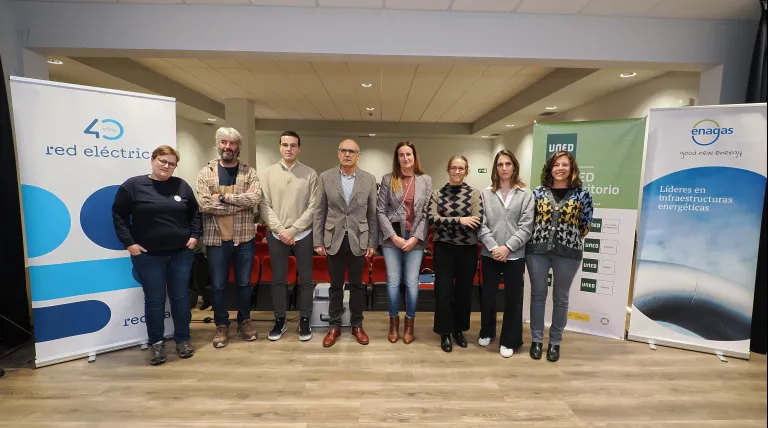
- Today and tomorrow, Cistierna (León) hosts the third edition of the Pastoreo en Red conference, organised by Red Eléctrica, Enagás, Agrovidar, Fundación Global Nature, and UNED Ponferrada. The event will gather livestock farmers, shepherds, public administration, energy transmission companies, universities, and social entities to discuss experiences in Spain of using conservation grazing with livestock for vegetation control.
Red Eléctrica's Pastoreo en Red initiative began five years ago in La Rioja to control the vegetation growing under the transmission grid power lines using conservation grazing with livestock. Since then, this initiative, which falls under the company's Comprehensive Impact Strategy, has expanded to other regions such as Castilla y León, Galicia, Asturias, and Aragón. To date, a total grazed area of 146 hectares has been achieved thanks to the action of 4,085 head of livestock guided by 19 local shepherds participating in the programme. Of these, almost half are women, a figure that is even higher in León, where women make up the majority.
In the mountains of León, an area classified as a Globally Important Agricultural Heritage System (GIAHS), energy transmission companies Red Eléctrica and Enagás manage the vegetation around their infrastructure using conservation grazing with livestock, through collaboration with shepherds, livestock farmers, and technical support from the company Agrovidar. Since 2022, 2,840 head of livestock have grazed along this infrastructure: sheep (2,400), cows (405), and equines (35). This spans over 75 hectares distributed across the municipalities of La Robla, Villamanín, Pola de Gordón, La Ercina, Cistierna, and Valderrueda. In the case of Cabrales (Asturias), since the beginning of this year, 615 animals (398 cattle, 180 goats, 80 sheep, and 13 equines) have grazed on 67 hectares of Red Eléctrica's transmission grid. In the province of Huesca, 10 mares and donkeys graze along a section of Enagás's Serrablo–Zaragoza gas pipeline.
Evaluations conducted in various areas of the Alto Bernesga Biosphere Reserve in León have demonstrated the effectiveness of this method as a tool for vegetation control and maintenance. Data collected so far by the “Biodiversity Studies”, which evaluate the impact of Pastoreo en Red over the years 2023–2025, confirm a greater abundance of faunal biodiversity in grazed areas compared to those where flocks do not graze frequently. This is particularly true for flying arthropods linked to pollination and decomposition processes, soil fauna, and floral units. A change in vegetation dynamics and soil improvement has also been detected, with a greater presence of herbaceous plants, associated with a lower risk of forest fires.
In this regard, clearing activities prevent vegetation growth from reaching the power lines, thus reducing the risk of forest fires. Furthermore, this initiative promotes rural development, helping to anchor populations in the territories and supporting their economic and social development.
In 2022, Pastoreo en Red was recognised as a “Nature-based Solution” (NbS) according to the standards of the International Union for Conservation of Nature (IUCN). It is the only Spanish initiative among 21 global best practices included in a publication by the international organisation.
Conference on Grazing in Networks in Cistierna
In this context, this Thursday and Friday Cistierna (León) hosts the third edition of the Pastoreo en las Redes conference, aiming to showcase practical experiences of using conservation grazing with livestock to control vegetation in different parts of Spain. This conference will focus on advancing the evaluation of ecosystem services that extensive livestock farming can provide in accordance with established objectives and a Pasture Plan.
The Conference is organised by Red Eléctrica, Enagás, Agrovidar, Fundación Global Nature, and UNED Ponferrada, with the support of the Provincial Council of León, the Cistierna Town Council, the Alto Bernesga Biosphere Reserve, and the León Mountain Livestock Farmers Association. It will bring together livestock farmers and shepherds, livestock service technicians, energy transmission companies, public administrations, universities, training centres, and third-sector entities related to grazing.
On Friday, the conference will conclude with a field visit featuring livestock to the project “Vegetation control under Red Eléctrica power lines using grazed extensive livestock” in the town of Paradilla de Gordón, in Pola de Gordón.
Downloads